AI in Supply Chain 2026: Why the Real Transformation Is Still Ahead of Us
AI is on every strategy roadmap, yet most organizations still don't see real, measurable ROI — because we're deploying AI without giving it the operational context it needs to matter.
 Valentina Jordan CEO and Co-Founder of Nauta
Working closely with shippers, importers, freight forwarders and logistics operators over the last few years, I'm seeing a clear paradox as we head into 2026:
• AI is on every strategy roadmap. • Most organizations still don't see real, measurable ROI.
AI pilots are everywhere. True operational transformation is rare. That's not because AI is overhyped or the technology isn't ready; it's because of how we're using it. Right now, most deployments are focused on narrow task automation: document extraction, email drafting, simple ETA predictions, chat interfaces on top of existing systems. These are helpful, but they're not transformational. They don't change how decisions are made, how risk is managed, or how networks are run.
The core problem is simple: "We are deploying AI without giving it the operational context it needs to matter." In logistics and supply chain, context is everything: contracts, service levels, constraints, tribal knowledge, and exceptions. Without that, AI remains an impressive demo layered on top of the same old processes.
Below are my predictions for how AI will actually reshape logistics in 2026, and why many organizations will feel frustrated before they see the upside.
1. ROI Frustration: Task Automation Without Context Hits a Ceiling
Most companies began their AI journey in safe territory: • Auto-drafting customer emails and updates • Extracting fields from invoices, POs, and bills of lading • Generating summaries of exceptions and delays • Basic demand or ETA predictions
These use cases reduce manual effort and create localized productivity gains. But they rarely transform cost-to-serve, working capital, or resilience. The reason: AI is being treated as a generic engine applied to non-generic operations. Every network has its own: • Routing rules and preferences • Risk thresholds and service trade-offs • Customer promises and unwritten rules • Escalation paths and exception-handling habits
If AI doesn't see these, it can't optimize around them.
My view for 2026: Most organizations will continue to be disappointed by AI ROI until they are willing to expose the true operational logic: data, rules, and tribal knowledge behind their decisions.
That means: • Encoding actual decision logic, not just formal SOPs • Allowing AI to observe end-to-end flows, not just individual touchpoints • Connecting AI to cross-system signals (ERP, TMS, WMS, emails, portals, IoT) under solid governance
The real step change comes from personalized operational intelligence: AI that understands your lanes, your contracts, your constraints, and your customers, while empowering companies through industry patterns and know how.
2. A New AI Infrastructure Layer: The ERP Problem All Over Again
A major reason many AI projects stall is that the underlying data is not fit for purpose.
Logistics and supply chain data is often: • Fragmented across partners, systems, and spreadsheets • Buried inside documents, PDFs, emails, and chat threads • Inconsistent semantic in entities such as products, locations and partners • Locked in systems that were never designed for real-time access
Organizations see this when they try to scale a successful pilot and suddenly discover it doesn't work outside the lab.
In 2026, we'll see the emergence of AI infrastructure for operations as a distinct layer, with companies investing in: • Data normalization and standardization across carriers, forwarders, facilities, and regions • Event-driven architectures that let AI "watch" shipments, orders, and inventory as they change in real time • Operational knowledge bases that encode business rules, playbooks, and exception-handling logic • Monitoring and feedback loops to track AI decisions and outcomes
It will feel a lot like implementing an ERP in a legacy organization: it forces hard conversations about ownership, definitions, and process. But it's unavoidable.
A simple principle for 2026: "You cannot be serious about AI if your most important operational truths still live in spreadsheets and email threads." The companies that move early on this infrastructure will be the ones that turn AI from a demo into a durable advantage.
3. Shippers Gain Leverage; Carriers See Rising Service and Claims Pressure
AI doesn't just automate workflows, it changes who has leverage in the relationship. Shippers and BCOs are beginning to use AI to: • Compare carrier performance across lanes in a structured way • Identify patterns in delays by port, service, or vessel • Quantify the financial impact of disruptions across SKUs and customers • Generate well-documented claims with supporting evidence at scale
As visibility tools and regulatory requirements push more data into the open, AI helps shippers connect dots that used to be too complex or time-consuming to analyze.
The consequence for 2026: Customer expectations on carriers, maritime lines, and operators will increase sharply, not because operations suddenly get worse, but because performance becomes far more transparent.
This will drive: • Higher volumes of inquiries and disputes • More detailed expectations for root-cause analysis • Pressure to respond faster, with data-backed answers
To keep up, carriers and operators will have to deploy their own AI capabilities to: • Triage and respond to customer questions efficiently • Automate claims workflows and supporting documentation • Proactively flag high-risk sailings and shipments • Prioritize exceptions based on value and impact
AI becomes not just an opportunity, but a defensive necessity for maintaining service quality and margins in an environment where customers are armed with better data.
4. The Agentic Layer: AI as a Central Decision-Orchestration Hub
One of the most important shifts I expect in 2026 is the move from AI as a support tool to AI as an orchestration layer.
Agentic AI doesn't just answer questions; it takes actions toward a goal under defined constraints. In supply chain, that means agents that: • Monitor signals (delays, forecasts, capacity changes) • Propose and sometimes execute decisions (re-routing, re-booking, re-ordering) • Learn from the outcomes of those decisions over time
In practice, this could look like: • Procurement agents that monitor supplier performance and risk, recommend alternative sources, and trigger pre-approved spot buys • Logistics agents that design and adjust multimodal routes in near real time based on disruptions and costs • Inventory agents that continuously tune reorder points, safety stock, and allocation based on demand and lead-time variability • Compliance agents that assemble filings, validate documentation, and keep up with changing rules and classifications
By the end of 2026, leading organizations will begin to operate with a central AI decision layer: A kind of "control tower that actually controls," where humans define policies and guardrails, and agents handle the bulk of the micro-decisions.
This won't eliminate planners and operators, but it will redefine their work. Their focus shifts from manual decision execution to: • Designing and refining policies • Overseeing exceptions and escalations • Training and supervising agents • Focusing on high-stakes customer and supplier relationships
This agentic layer will be one of the clearest differentiators between companies that still "use AI" and those that have truly rewired their operating model around it.
5. Metadata and Traceability: Product Knowledge Goes from Fragmented to Exponential
Right now, product knowledge in most organizations is fragmented and fragile: • Technical specifications in one system • Regulatory and certification details in another • Quality incidents in emails and PDFs • Handling requirements hidden in contracts or people's memory
At the same time, traceability, ESG requirements, and regulatory expectations are increasing, not decreasing. Product metadata is becoming more important, and more complex, than ever.
AI thrives in this environment when metadata is structured and connected.
In 2026, I expect a major acceleration in: • End-to-end traceability: linking each product or lot to a detailed journey across factories, modes, and borders • Automated compliance: AI agents assembling documentation and evidence for audits and regulatory filings • Smarter recalls and risk shields: isolating affected batches, lanes, or suppliers quickly when an issue appears • Dynamic handling and routing: choosing routes and partners based on product-specific conditions (temperature, shelf life, sensitivity, local rules)
The key shift is that product metadata stops being "documentation" and becomes live operational input, data that AI can reason about to drive better decisions.
What was once promised by theoretical architectures like blockchain will increasingly be realized through AI + rich metadata + connected stakeholders.
6. AI Agents as True Team Members
Another under-estimated change coming in 2026 is cultural: AI stops being a "feature" and becomes part of the org chart.
Many teams will have agents that: • Reconcile freight and accessorial invoices against contracts and milestones • Monitor high-risk shipments and escalate proactively • Compile weekly and monthly performance reviews • Maintain master data by detecting anomalies and proposing corrections
It will become normal to say things like "the agent flagged this lane overnight" or "the agent prepared the first draft of this analysis." The challenge then becomes: how do we integrate these agents as responsible, governed contributors?
That will require: • Clear definitions of scope and authority for each agent • Metrics and SLAs for agent performance • Review cycles where humans evaluate and adjust agent behavior • Transparency into why agents made the decisions they did
In other words, we'll need to learn how to manage AI colleagues, not just deploy AI tools.
7. Data Governance and Resilient Models: Built for Volatility, Not Just Efficiency
Supply chains are increasingly shaped by volatility: climate events, cyber incidents, geopolitical shifts, regulatory shocks, and labor disruptions.
AI models trained solely for efficiency in "normal" conditions will misfire when those conditions break. That's why resilience and governance will be core to serious AI strategies in 2026.
The leaders will: • Track data lineage for important decisions: what inputs and assumptions led to this recommendation? • Use multiple models and signals rather than relying on a single black box • Implement real-time monitoring of AI outputs, with clear thresholds for human intervention • Run scenario simulations using AI to test how the network and the decision logic behave under stress
The mindset shift is critical:
"AI for operations is not a one-off project. It's a living system that needs to be monitored, trained, audited, and adjusted over time."
Organizations that embrace this will be able to use AI not just to optimize today, but to navigate tomorrow's disruptions more intelligently.
What Leaders Should Actually Do in 2026
Turning these predictions into action, a practical agenda for 2026 might look like this:
1. Map the decisions that matter most. Identify the recurring decisions that drive cost, service, and risk (e.g., routing choices, allocation, prioritization, claims, supplier selection). These are where AI should focus first.
2. Expose real operational logic to AI. Move beyond surface-level data. Capture the rules, playbooks, and "if X then Y" patterns that your best people use every day.
3. Invest in AI-ready data infrastructure. Normalize key data, build event streams, and create knowledge bases. Make it possible for AI to see end-to-end flows, not isolated snapshots.
4. Pilot an agentic layer in one domain. Choose a high-impact area like exception management, claims, or inbound imports. Give an AI agent a clear mandate, guardrails, and KPIs, and let it operate under human supervision.
5. Build governance from day one. Decide what agents can do autonomously, what requires approval, and how outputs will be monitored, audited, and improved.
6. Position AI as augmentation, not replacement. Involve frontline teams in critiquing AI decisions. Show them how agents eliminate low-value work so they can focus on complex, relationship-driven, and strategic tasks.
From Experiments to Operating Model Change
Logistics will always be a world of real constraints, ports, capacity, regulations, weather, geopolitics. AI doesn't erase those constraints. What it can change is how quickly and intelligently we sense them, adapt to them, and learn from them.
The coming year will draw a clearer line between two types of organizations: • Those that treat AI as a set of isolated tools to make existing processes slightly faster • Those that are willing to expose their real operations, data, decisions, and knowledge, to AI in a structured, governed way, and rebuild how work gets done
The second group will create supply chains that are leaner, more resilient, and more adaptive, with human experts and AI agents working together.
AI will not replace logistics professionals. But logistics professionals and companies who build context-rich, agentic, and well-governed AI into their operations will dramatically outperform those who don't.
Frequently Asked Questions
Why don't most organizations see measurable ROI from AI in supply chains?
Because AI is being deployed without the operational context it needs to matter. Most deployments focus on narrow task automation like document extraction, email drafting, and simple ETA predictions, which reduce manual effort but do not change how decisions are made or how networks are run. In logistics and supply chain, context is everything: contracts, service levels, constraints, tribal knowledge, and exceptions, and without it AI stays an impressive demo layered on the same old processes.
Why does AI task automation hit a ceiling without operational context?
Task automation creates localized productivity gains but rarely transforms cost-to-serve, working capital, or resilience, because AI is treated as a generic engine applied to non-generic operations. Every network has its own routing rules, risk thresholds, customer promises, and escalation paths. If AI cannot see these, it cannot act around them, so ROI stays disappointing until companies expose the real decision logic, rules, and tribal knowledge behind their operations.
What is the agentic layer in supply chains?
The agentic layer is the shift from AI as a support tool to AI as a decision-orchestration hub. Agentic AI does not just answer questions; it takes actions toward a goal under defined constraints, monitoring signals, proposing and sometimes executing decisions like re-routing, re-booking, and re-ordering, and learning from the outcomes. By the end of 2026, leading organizations will operate with a central AI decision layer, a control tower that actually controls, where humans define policies and guardrails and agents handle the bulk of the micro-decisions.
How is AI shifting leverage from carriers to shippers?
Shippers and BCOs are using AI to compare carrier performance across lanes, identify delay patterns by port and vessel, quantify the financial impact of disruptions across SKUs and customers, and generate well-documented claims with supporting evidence at scale. As performance becomes far more transparent, customer expectations on carriers rise sharply, driving higher volumes of disputes and pressure to respond faster with data-backed answers. Carriers then have to deploy their own AI as a defensive necessity to protect service quality and margins.
Why do AI supply chain pilots stall when teams try to scale them?
Because the underlying data is often not fit for purpose: fragmented across partners and spreadsheets, buried in PDFs, emails, and chat threads, semantically inconsistent across products and locations, and locked in systems never designed for real-time access. Teams discover that a successful pilot does not work outside the lab. Serious AI requires a distinct infrastructure layer with data normalization, event-driven architectures, operational knowledge bases, and feedback loops, an effort that feels like implementing an ERP in a legacy organization.
What should supply chain leaders actually do about AI in 2026?
Start by mapping the recurring decisions that drive cost, service, and risk, and focus AI there first. Expose the real operational logic, the rules and playbooks your best people use every day, rather than surface-level data, and invest in AI-ready data infrastructure so AI can observe end-to-end flows instead of isolated snapshots. Then pilot an agentic layer in one high-impact domain with a clear mandate, guardrails, and KPIs under human supervision, and build governance from day one.
Keep reading
September 2026
The Foundation Problem: Why AI Pilots in Global Trade Keep Failing
Nauta’s Valentina Jordan, writing for Talking Logistics, on why AI pilots in global trade stall before production — and what a foundation-first, compounding approach looks like instead.
Read more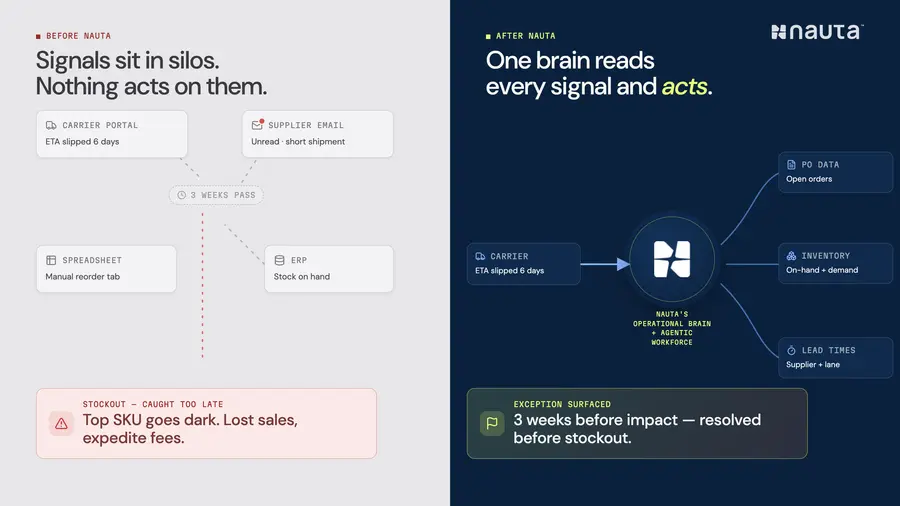
The Disruptions You Already Saw Coming: Why Supply Chain Signals Get Lost
Most disruptions are not invisible. The signal existed, it just never reached the person who could act on it. That is an infrastructure problem, not a forecasting one.
Read more
Unstructured Exception Management Is Driving Your Detention and Demurrage Costs
Unstructured exception management turns each disruption into a potential source of detention and demurrage costs that compound before anyone sees them coming.
Read more