Nauta Inventory Optimization Engine: Prevent Stockouts
Today, we launched the Nauta Inventory Optimization Engine, an AI-powered engine that enables shippers to plan inventory with the context of their own proprietary supply chain data.
 Valentina Jordan CEO and Co-Founder of Nauta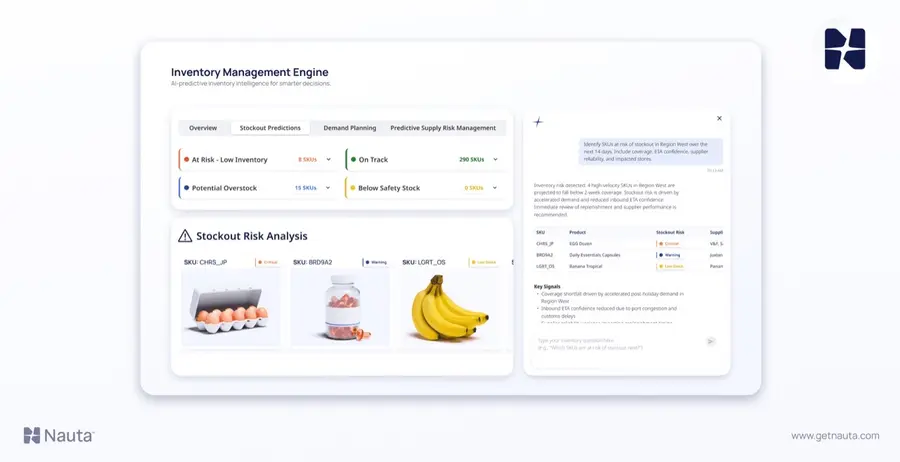
Today, we launched the Nauta Inventory Optimization Engine, an AI-powered engine that enables shippers to plan inventory with the context of their own proprietary supply chain data.
Volatile demand, longer lead times, and increasingly complex distribution networks are forcing procurement, supply chain, and operations teams to rethink how they plan inventory and maintain service levels. But the data infrastructure and quality they rely on is unreliable, at best.
Valentina Jordan, CEO and Co-Founder of Nauta, discusses the newly launched Nauta Inventory Optimization Engine, and why we need to fix the data infrastructure layer of global supply chains in order to make real gains across stockouts, fill rates and inventory management processes.
There's plenty of inventory management solutions on the market. Why build the Inventory Optimization Engine, and what makes it different?
Shippers have long struggled to make inventory decisions using fragmented systems and retrospective data. During high-stakes moments, like the holiday season, peak, threats of tariff hikes and more, those limitations become painful. Our customers needed a way to understand, in real time, where their inventory was, what was likely to run short, and how potential shortages would impact revenue.
What we built is an AI-powered engine grounded in a unified data foundation. It structures a shipper's proprietary data, across ERP, WMS, TMS, purchase orders, shipments, and more, down to the SKU level. That single source of truth allows teams to anticipate constraints earlier and take proactive action across procurement, replenishment, and allocation.
What makes real-time, SKU-level intelligence so critical?
If a shipper can't see what's moving, where it's moving, and what inventory is at risk, they're operating blind. A single stockout frustrates customers, and it can result in severe financial penalties, lost revenue, and downstream operational disruption.
With Nauta, shippers can monitor SKU-level performance and stockout risk continuously.
They're no longer relying on spreadsheets, emails, or manual workflows to make urgent decisions. Instead, they have predictive insights that highlight where exposure exists and what actions can prevent issues before they occur. That's especially important when demand surges and teams need clarity, speed, and accuracy.
How are customers using Nauta to reduce stockout risk and protect revenue?
One of our customers a 30-year leader in packaging materials for pharmaceutical companies used Nauta to unify and structure their inventory data. With our predictive insights, they could anticipate SKU shortages earlier and avoid financial penalties. In just one quarter, that meant more than $1.2 million in preserved revenue.
Another customer, WindMar Home, the leading residential solar contractor in the Caribbean, used Nauta's AI-native engine to streamline inventory visibility across departments. Since working with us, they've increased fill rates by 1.3%, resulting in hundreds of thousands of dollars in protected revenue. As their CEO, Juan Jose Gonzales, put it: Nauta gave them confidence that their solar panels and batteries would always be available when customers needed installations.
Many shippers still operate on disparate systems. How does Nauta address this foundational challenge?
This is the core problem we set out to solve. Most shippers have valuable data, but it's not in a form that's usable, connected, or actionable. Legacy systems aren't designed to talk to each other, so decision-makers end up stitching data together manually or relying on historical reports.
Our operating system creates the industry's first unified data infrastructure layer for supply chains. We harmonize incoming data across all systems – ERP, WMS, TMS, and others – and structure it at the product level. With that foundation in place, AI can finally be useful. You can't build predictive intelligence on messy data. You need real-time, high-quality, harmonized information. That's what unlocks automated workflows and accurate, forward-looking insights.
How does AI transform decision-making across procurement and replenishment workflows?
When teams can see stockout risk weeks earlier, they gain options. They can reroute inventory, adjust procurement plans, shift allocation strategies, or accelerate replenishment. AI models inside Nauta surface not just what's likely to run short, but why, and what the recommended next steps should be. The result is a shift from firefighter mode to proactive planning. Instead of reacting to shortages, teams are preventing them.
Nauta has experienced significant growth this year. What's driving demand?
Since launching in January 2025, we've raised $7 million in seed funding led by Construct Capital and Predictive and grown revenue by 23x, with our food and beverage customer segment expanding more than 7x.
The demand is simple: shippers need clarity. They need automation. And they need a reliable, real-time way to understand their exposure especially during seasonal peaks. Our AI-native architecture and unified data layer give them exactly that. It's why we're seeing adoption across industries, from manufacturing to food & beverage to renewable energy. If you care about maintaining service levels and protecting revenue, data-driven inventory management is no longer optional.
AI-native supply chain intelligence for a world that never stops.
Frequently Asked Questions
What is the Nauta Inventory Optimization Engine?
The Nauta Inventory Optimization Engine is an AI-powered engine that lets shippers plan inventory with the context of their own proprietary supply chain data. It structures a shipper's data across ERP, WMS, TMS, purchase orders, and shipments down to the SKU level, creating a single source of truth that lets teams anticipate constraints earlier and act proactively across procurement, replenishment, and allocation.
Why is real-time, SKU-level inventory intelligence critical?
Without it, a shipper cannot see what is moving, where it is moving, or what inventory is at risk, which means operating blind. A single stockout frustrates customers and can trigger severe financial penalties, lost revenue, and downstream disruption. Real-time, SKU-level intelligence lets teams monitor stockout risk continuously and act before a shortage becomes a cost.
How does Nauta help shippers avoid holiday-season stockouts?
During high-stakes moments like peak and the holiday season, fragmented systems and retrospective data leave teams exposed. Nauta gives shippers predictive insights that highlight where inventory exposure exists and what actions prevent issues before they occur, so teams have clarity and speed exactly when demand surges. They stop relying on spreadsheets, emails, and manual workflows to make urgent decisions.
Do I need to replace my ERP or WMS to use the engine?
No. Nauta harmonizes incoming data across ERP, WMS, TMS, and other systems and structures it at the product level, building a unified data foundation on top of the systems you already run. Your systems of record stay in place; the engine adds real-time, SKU-level predictive intelligence above them.
What results have Nauta customers seen with the engine?
A 30-year leader in packaging materials for pharmaceutical companies used Nauta to unify and structure inventory data, anticipate SKU shortages earlier, and avoid financial penalties, preserving more than $1.2 million in revenue in a single quarter. WindMar Home, the leading residential solar contractor in the Caribbean, increased fill rates by 1.3%, protecting hundreds of thousands of dollars in revenue.
Keep reading

August 2026
BMW i Ventures, Bosch Ventures, Hitachi Ventures & Yamaha Motor Ventures Lead Strategic Investment in Nauta
Four of the world’s leading corporate venture arms — BMW i Ventures, Bosch Ventures, Hitachi Ventures, and Yamaha Motor Ventures — lead a strategic investment in Nauta, the operational brain powering autonomous AI agents for global trade, with participation from existing investors Construct Capital and Predictive.
Read more
June 2026
Nauta Named One of the Top 10 Supply Chain Startups of 2026
Nauta has been named one of the Top 10 Supply Chain Startups of 2026 by Supply Chain Digital, a recognition that places the company among the teams reshaping how global supply chains operate.
Read more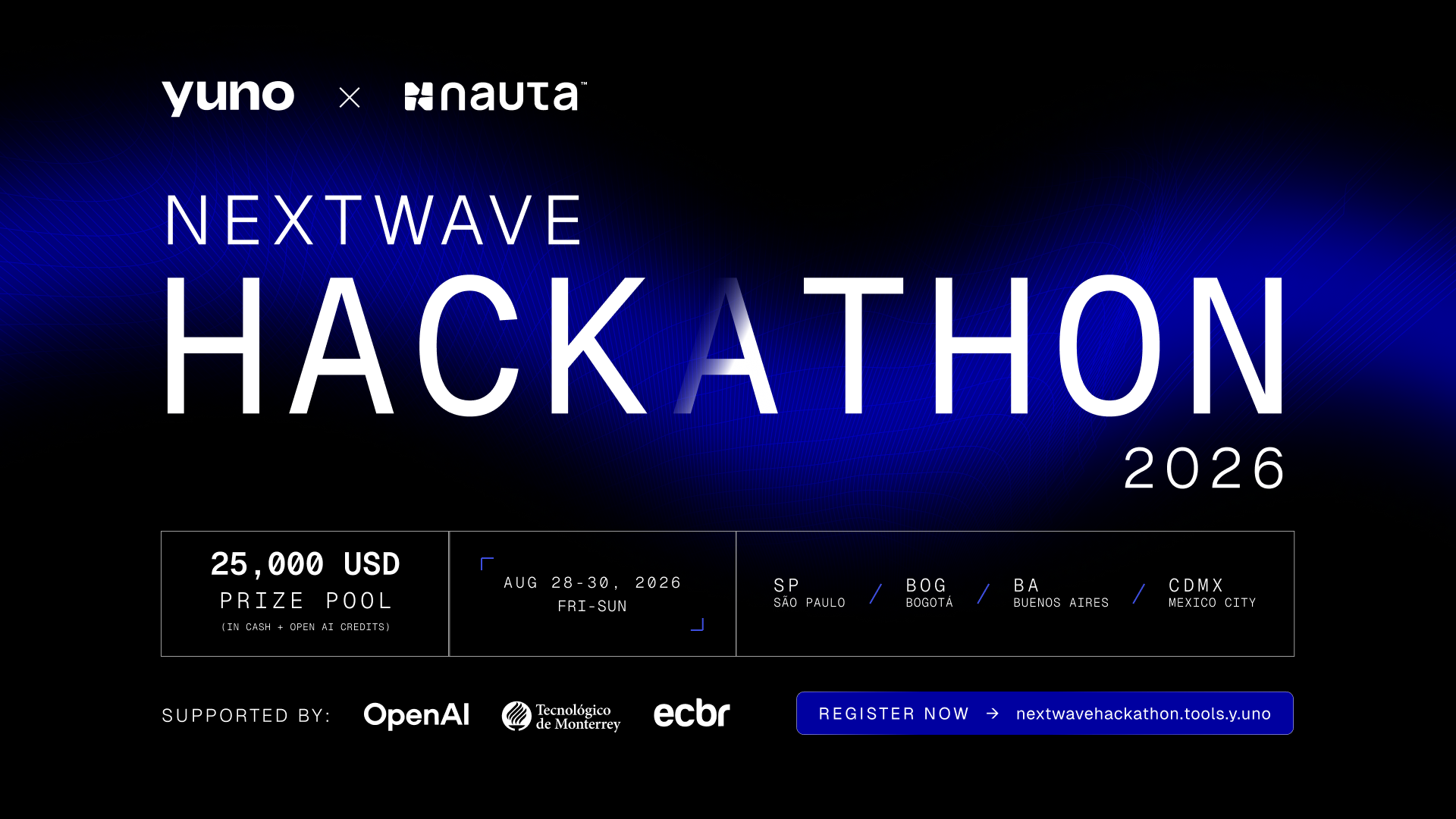
July 2026
NextWave 2026: AI Hackathon Across Four LATAM Cities
Nauta and Yuno bring NextWave 2026 to Bogota, Mexico City, Buenos Aires and Sao Paulo, August 28 to 30. Free entry, 25,000 USD in prizes, OpenAI API access.
Read more