NextWave 2026: four cities, 24 hours, one weekend of building with OpenAI
Four cities. One clock. Twenty-four hours to ship something real.
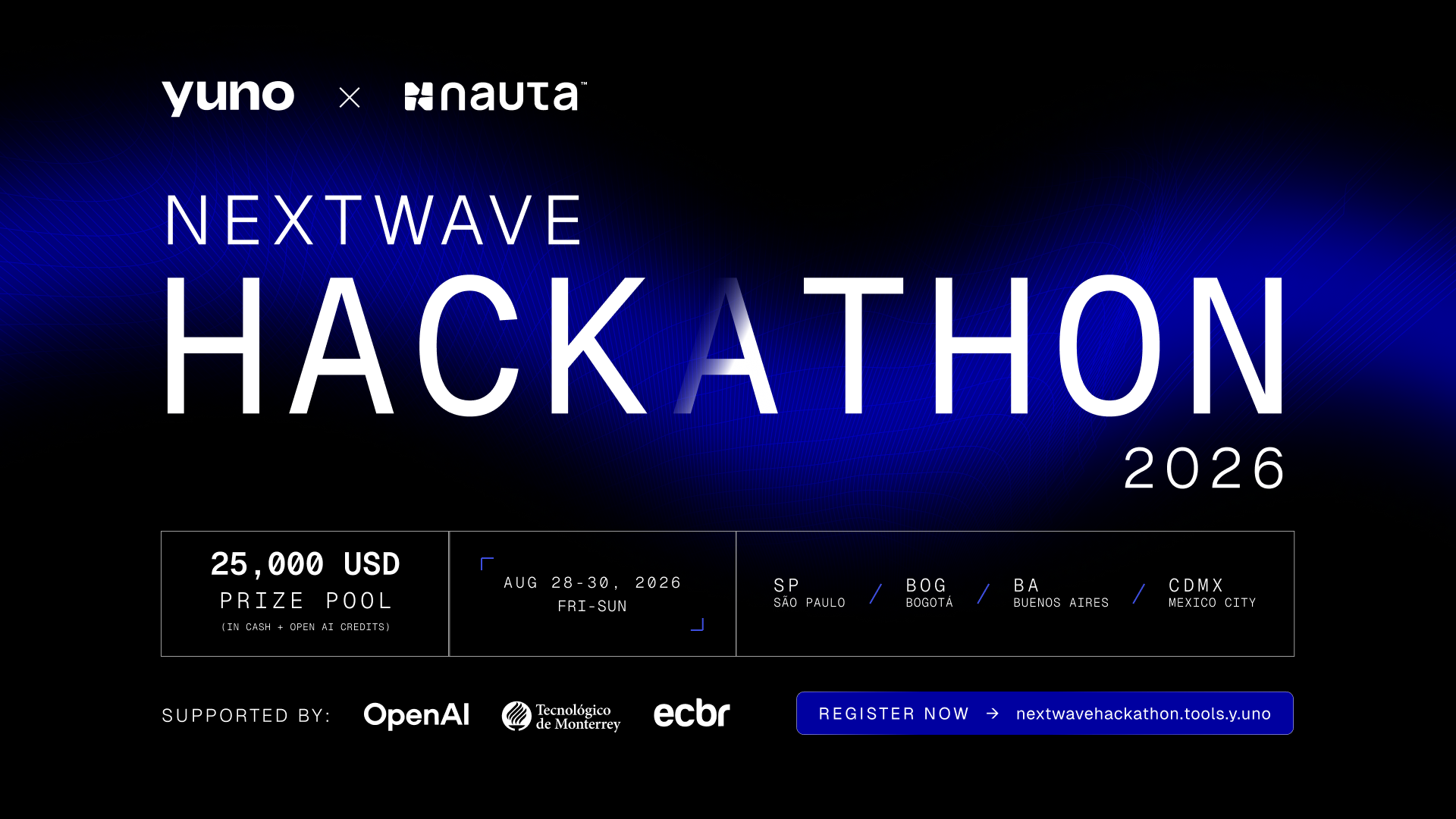
NextWave 2026 runs from August 28 to 30 across Bogota, Mexico City, Buenos Aires and Sao Paulo. It is presented by Yuno with Nauta, supported by OpenAI, Tec de Monterrey, Universidad Torcuato Di Tella and ECBR. Registration is free, meals are covered, and every builder gets ChatGPT and OpenAI API access for the full weekend.
One hundred and sixty builders. Forty teams of four. Ten teams per city, all working the same problems on the same clock, and a global finale livestreamed across Latin America on Sunday.
What the weekend looks like
Challenges stay sealed until Saturday morning. That is the point. Teams walk in without a head start and have to read an unfamiliar problem, decide what matters, and build against it before the clock runs out.
- Friday, August 28: opening ceremony and an OpenAI talk, 18:00 Bogota, 17:00 Mexico City, 20:00 Buenos Aires and Sao Paulo
- Saturday, August 29: doors open 08:00, challenges revealed 09:00, coding starts 09:30, mentors on the floor, all-night working sessions
- Sunday, August 30: code freeze 11:00, local pitches 12:30, city champions announced 14:00, global finale livestreamed from 15:00 Bogota
Every team pitches. City champions go to the global stage, pitching live in the order Sao Paulo, Buenos Aires, Bogota, Mexico City.
Each crew ships four things by the freeze: a presentation, a working demo, a public GitHub repo with a README, and an architecture diagram. The architecture diagram is not a formality. It is where you see whether a team understood the problem or just built around it.
Why Nauta is on the floor
Nauta is the operational brain for global supply chains. It connects data from emails, spreadsheets, supplier portals, ERP, TMS and WMS into one AI-ready data layer, and purpose-built agents run on top of that layer around the clock, predicting stockouts, shipment delays and cost anomalies weeks before they reach the P&L.
That work taught us something we keep running into at events like this one. Anyone can buy an agent. What an agent is worth depends entirely on the context underneath it, the accumulated knowledge of how one specific operation actually runs, which suppliers slip, which lanes fail in August, which exception is worth a phone call and which one resolves itself. Agents act. Humans decide. The layer in between is the hard part, and it is the part that gets skipped.
Twenty-four hours is a good filter for that. Teams that start from the model tend to demo something impressive that does not hold. Teams that start from the problem, from the messy operational reality of whoever is supposed to use the thing, ship less and it works.
Nauta engineers will be mentoring alongside Yuno engineers at every site: architecture reviews, pitch sharpening, and blunt feedback while there is still time to act on it. Valentina Jordan, Nauta's CEO and co-founder, hosts the Mexico City site.
The four sites
- Bogota, host Daniel Lozano. Home of the first champions
- Mexico City, hosted by Valentina Jordan, CEO and co-founder of Nauta, alongside Mauricio Schwartzmann. The region's largest tech hub joins the second edition
- Buenos Aires, host Juan Manuel Rebull
- Sao Paulo, host Walter Campos
Each site runs on local time with a shared opening ceremony and a shared finale.
Prizes
The pool is 25,000 USD in cash and OpenAI credits.
- First place: 12,000 USD, split as 7,000 in cash and 5,000 in OpenAI credits, 3,000 per crew member
- Second place: 8,000 USD, 5,500 in cash and 2,500 in credits, 2,000 per crew member
- Third place: 5,000 USD, 4,000 in cash and 1,000 in credits, 1,250 per crew member
City champions get the global stage, merch and a certificate. All 160 builders leave with a certificate and merch.
The first edition set the bar
NextWave started in Bogota in December 2025. One city, one weekend, 52 builders across 11 teams.
The winning project, 4thena, indexed sales signals scattered across WhatsApp, Telegram, LinkedIn and Slack into a single queryable memory, then generated fully specced design documents on demand. A student team built it in 24 hours. The thing that made it win was not the model choice. It was that they understood the actual problem: the signal was never missing, it was just spread across four places nobody could search at once.
How to register
Registration is open now at luma.com/nextwavehackathon and closes on August 24. Register with your crew of four, or register solo and get matched before the weekend starts.
Direct site links: Bogota · Mexico City · Buenos Aires · Sao Paulo
Full details at nextwavehackathon.tools.y.uno.
Questions before you register
Who can join?
Anyone who can build and ship. There is no student requirement and no professional requirement.
What does it cost?
Nothing. Entry is free and meals and snacks are covered for the full weekend. Register on Luma for your city, get accepted, show up ready to build.
How big are teams?
Four members, fixed. Ten teams per city, 40 total across the four sites. You can register as a full crew or solo and be matched before the event.
What language is the event in?
Official materials and pitches are in English. Inside the 24 hours, teams work in whatever language they want.
What do teams have to deliver?
A presentation, a demo either live or on video, a public GitHub repo with a README, and an architecture diagram.
What should I bring?
A laptop and a charger. Power, wifi and everything else is on site.
Who is behind NextWave?
NextWave is presented by Yuno with Nauta, supported by OpenAI, Tec de Monterrey, Universidad Torcuato Di Tella and ECBR. Prizes are subject to the official contest terms and conditions.
NextWave 2026: cuatro ciudades, 24 horas, un fin de semana construyendo con OpenAI
Cuatro ciudades. Un mismo reloj. Veinticuatro horas para construir algo real.
NextWave 2026 se corre del 28 al 30 de agosto en Bogota, Ciudad de Mexico, Buenos Aires y Sao Paulo. Lo presenta Yuno junto a Nauta, con el apoyo de OpenAI, Tec de Monterrey, Universidad Torcuato Di Tella y ECBR. El registro es gratis, las comidas estan cubiertas y cada participante recibe acceso a ChatGPT y a la API de OpenAI durante todo el fin de semana.
Ciento sesenta builders. Cuarenta equipos de cuatro. Diez equipos por ciudad, todos trabajando los mismos retos contra el mismo reloj, y una final global transmitida en vivo para toda la region el domingo.
Como se vive el fin de semana
Los retos quedan sellados hasta el sabado por la manana. Ese es el punto. Los equipos llegan sin ventaja y tienen que leer un problema desconocido, decidir que importa y construir contra eso antes de que se acabe el tiempo.
- Viernes 28 de agosto: ceremonia de apertura y charla de OpenAI, 18:00 Bogota, 17:00 Ciudad de Mexico, 20:00 Buenos Aires y Sao Paulo
- Sabado 29 de agosto: puertas abiertas 08:00, retos revelados 09:00, arranca el codigo 09:30, mentores en piso, sesiones de trabajo toda la noche
- Domingo 30 de agosto: cierre de codigo 11:00, pitches locales 12:30, campeones por ciudad 14:00, final global transmitida en vivo desde las 15:00 Bogota
Todos los equipos presentan. Los campeones de cada ciudad pasan al escenario global y presentan en vivo en este orden: Sao Paulo, Buenos Aires, Bogota, Ciudad de Mexico.
Cada equipo entrega cuatro cosas antes del cierre: una presentacion, un demo en vivo o en video, un repositorio publico de GitHub con README y un diagrama de arquitectura. El diagrama de arquitectura no es un tramite. Ahi se ve si un equipo entendio el problema o si solo construyo alrededor de el.
Por que Nauta esta en el piso
Nauta es el cerebro operativo de las cadenas de suministro globales. Conecta datos de correos, hojas de calculo, portales de proveedores, ERP, TMS y WMS en una sola capa de datos lista para IA, sin necesidad de un equipo de ingenieria de datos. Agentes construidos para cada problema trabajan sobre esa capa 24/7 y anticipan quiebres de stock, retrasos de embarques y anomalias de costo semanas antes de que lleguen al P&L.
Ese trabajo nos enseno algo que se repite en eventos como este. Cualquiera puede comprar un agente. Lo que ese agente vale depende por completo del contexto que tiene debajo: el conocimiento acumulado de como funciona una operacion especifica, que proveedores fallan, que rutas se caen en agosto, que excepcion amerita una llamada y cual se resuelve sola. Los agentes actuan. Los humanos deciden. La capa que va en medio es la parte dificil, y es la parte que casi siempre se salta.
Veinticuatro horas son un buen filtro para eso. Los equipos que arrancan desde el modelo suelen mostrar un demo impresionante que no se sostiene. Los equipos que arrancan desde el problema, desde la realidad operativa de quien va a usar la cosa, entregan menos y funciona.
Los ingenieros de Nauta van a mentorear junto a los de Yuno en las cuatro sedes: revision de arquitectura, afinacion de pitch y feedback directo mientras todavia queda tiempo para actuar. Valentina Jordan, CEO y cofundadora de Nauta, es anfitriona de la sede de Ciudad de Mexico.
Las cuatro sedes
- Bogota, anfitrion Daniel Lozano. Casa de los primeros campeones
- Ciudad de Mexico, con Valentina Jordan, CEO y cofundadora de Nauta, junto a Mauricio Schwartzmann. El hub de tecnologia mas grande de la region se suma a la segunda edicion
- Buenos Aires, anfitrion Juan Manuel Rebull
- Sao Paulo, anfitrion Walter Campos
Cada sede corre en su horario local, con una ceremonia de apertura y una final compartidas.
Premios
La bolsa es de 25,000 USD entre efectivo y creditos de OpenAI.
- Primer lugar: 12,000 USD, repartidos en 7,000 en efectivo y 5,000 en creditos de OpenAI, 3,000 por integrante
- Segundo lugar: 8,000 USD, 5,500 en efectivo y 2,500 en creditos, 2,000 por integrante
- Tercer lugar: 5,000 USD, 4,000 en efectivo y 1,000 en creditos, 1,250 por integrante
Los campeones de cada ciudad se llevan el escenario global, merch y certificado. Los 160 participantes salen con certificado y merch.
La primera edicion puso la vara
NextWave arranco en Bogota en diciembre de 2025. Una ciudad, un fin de semana, 52 builders en 11 equipos.
El proyecto ganador, 4thena, indexo senales de ventas dispersas en WhatsApp, Telegram, LinkedIn y Slack en una sola memoria consultable, y desde ahi generaba documentos de diseno completos a pedido. Un equipo de estudiantes lo construyo en 24 horas. Lo que lo hizo ganar no fue la eleccion del modelo. Fue que entendieron el problema real: la senal nunca estuvo perdida, solo estaba repartida en cuatro lugares que nadie podia buscar al mismo tiempo.
Como registrarte
El registro esta abierto en luma.com/nextwavehackathon y cierra el 24 de agosto. Registrate con tu equipo de cuatro, o solo, y te asignamos equipo antes de que arranque el fin de semana.
Links directos por sede: Bogota · Ciudad de Mexico · Buenos Aires · Sao Paulo
Toda la informacion en nextwavehackathon.tools.y.uno.
Preguntas antes de registrarte
Quien puede participar?
Cualquier persona que sepa construir y entregar. No hay requisito de ser estudiante ni de ser profesional.
Cuanto cuesta?
Nada. La entrada es gratis y las comidas estan cubiertas todo el fin de semana. Te registras en Luma para tu sede, te aceptan y llegas listo para construir.
De cuantas personas son los equipos?
Cuatro integrantes, fijo. Diez equipos por sede, 40 en total entre las cuatro ciudades. Puedes registrarte con tu equipo completo o solo y te asignamos uno antes del evento.
En que idioma es el evento?
Los materiales oficiales y los pitches son en ingles. Durante las 24 horas, cada equipo trabaja en el idioma que quiera.
Que tiene que entregar cada equipo?
Una presentacion, un demo en vivo o en video, un repositorio publico de GitHub con README y un diagrama de arquitectura.
Que llevo?
Laptop y cargador. La sede pone energia, wifi y todo lo demas.
Quien esta detras de NextWave?
NextWave lo presenta Yuno junto a Nauta, con el apoyo de OpenAI, Tec de Monterrey, Universidad Torcuato Di Tella y ECBR. Los premios estan sujetos a los terminos y condiciones oficiales del concurso.