The Disruptions You Already Saw Coming: Why Supply Chain Signals Get Lost Before They Reach the Right Person
Most supply chain disruptions are not invisible. The signal existed. It just never reached the person who could act on it. That is not a forecasting failure, it is an infrastructure failure.
 Nauta Team Supply Chain Strategy Experts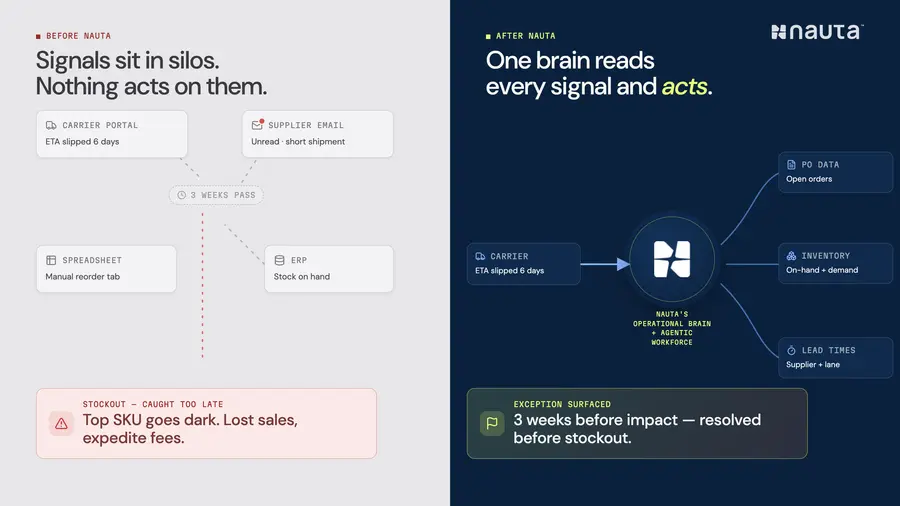
Most supply chain disruptions are not invisible. The signal existed. It just never reached the person who could act on it.
A carrier portal flagged a delay three weeks out. A freight forwarder mentioned port congestion in an email. A spreadsheet someone updated last Tuesday showed inventory coverage dropping below safety stock. None of it connected. None of it surfaced. By the time the stockout hit, your team was already in crisis mode, and the window to reorder, reroute, or renegotiate had closed.
That is not a forecasting failure. It is an infrastructure failure.
The Myth of the Invisible Disruption
Operations teams often describe major disruptions as things they "couldn't have seen coming." In most cases, that is not accurate. The data existed somewhere. The problem is that it lived in a system, inbox, or spreadsheet that no one connected to the people making decisions.
Gartner research shows that only 29% of supply chain organizations have future-ready capabilities, meaning the vast majority are still operating on fragmented data architectures that cannot route signals in time. A McKinsey analysis found that 45% of supply chain leaders have no visibility beyond their first-tier suppliers, which means disruptions forming two or three links back in the chain are effectively invisible by default. And 80% of supply chain leaders identify siloed data as the single biggest barrier to resilience.
Here is the uncomfortable part: even the visibility teams think they have is often an illusion. Studies show that 93% of supply chain teams report moderate-or-better visibility, yet true insight into Tier 2 and Tier 3 suppliers remains sharply limited. Teams feel informed because they have dashboards. They are not informed because those dashboards pull from incomplete, unconnected data.
The gap between "we have data" and "the right person saw the right signal in time to act" is where disruptions live.
Where Signals Actually Get Stuck
Think about how supply chain data moves in a typical mid-market operation. A carrier updates a shipment status in their portal. That update sits there until someone logs in to check it, which might happen tomorrow, or Friday, or not at all if the person responsible is out. Meanwhile, the ERP shows the purchase order as on track because no one has manually updated it. The planner looks at the ERP, sees green, and moves on.
The signal existed. The routing infrastructure did not.
The same pattern plays out across document exceptions. 80% of shipment delays trace back to missing or incorrect documents. Those errors are almost always visible in the paperwork before the delay becomes a physical reality. But if your document review process is manual and your systems do not talk to each other, the error sits in an inbox or a portal until someone happens to open it.
Demurrage is another example. Containers sitting at port because of documentation gaps or miscommunication can generate exposure up to $300,000 per year for a mid-market operator. That is not bad luck. That is a signal-routing problem. The container's status was visible. The connection between that status and the person authorized to release it was not.
And then there are invoices. When 39% of freight invoices contain errors and your team is reconciling them manually against spreadsheets and PDFs, the financial anomaly is sitting right there in the data. It just takes days or weeks to surface, long after the payment window has closed or the budget variance has already hit the P&L.
What "Connected" Actually Looks Like
The problem is not that supply chain data does not exist. The problem is that it lives in too many places, in too many formats, with no layer that reads all of it simultaneously and routes the relevant signal to the right person before the window closes.
Consider what changes when that layer exists.
A carrier portal updates a shipment status showing a seven-day delay on an inbound container. In a fragmented environment, that update sits in the portal. In a connected environment, an agent reads it, cross-references the corresponding purchase order, checks current inventory levels and lead times for that SKU, calculates the projected stockout date, and surfaces an exception to the planner, not as a raw data point, but as a decision: reorder now, or accept the risk of a gap in week four.
That is not prediction in the abstract sense. That is signal routing with financial context attached.
The planner does not need to log into four systems. They do not need to manually reconcile the carrier update against the ERP. The agent did that work continuously, overnight, across every open order in the system. The human sees only what needs a decision.
This is what exception-based operations actually means in practice. Not fewer alerts. Smarter routing of the alerts that matter.
Why Mid-Market Teams Are Especially Exposed
Enterprise operators have data engineering teams, dedicated integration staff, and the budget to build custom connectors between systems. Mid-market operators (importers, distributors, wholesalers, and manufacturers with $20 million to $500 million in revenue) typically do not.
Their data lives in an ERP, a TMS or freight portal, a WMS, a set of carrier emails, and a collection of spreadsheets that someone built two years ago and no one fully trusts. Each system works. None of them talk to each other in real time. The operations team spends a significant portion of their week pulling data from one place and manually entering it somewhere else.
That manual process is not just slow. It is the exact mechanism by which signals get lost. The carrier portal update that should have triggered a reorder decision instead sat unread while the team was reconciling last week's invoices.
How Nauta Closes the Gap
Nauta connects data from emails, spreadsheets, supplier portals, and enterprise systems (ERP, TMS, WMS) into a single AI-ready layer without requiring a data engineering team. Purpose-built agents run continuously on that layer, monitoring every open order, shipment, and inventory position across your operation.
When a signal appears, whether a carrier delay, a document exception, a cost anomaly, or an inventory coverage gap, the agent cross-references it against your contracts, your POs, your current stock levels, and your lead times. If it crosses a threshold that requires a decision, it surfaces an exception with the financial context attached. If it does not, it keeps monitoring.
Your team stops spending time looking for problems and starts spending time solving them. The signal routing that used to depend on someone logging into the right portal on the right day happens automatically, 24 hours a day.
Operators like Berrios Logistics and Windmar Solar have moved from reactive crisis management to exception-based operations using this model: fewer manual workflows, less guesswork, and a tighter cash-to-cash cycle.
The Question Worth Asking
Before your next disruption hits, ask yourself: where did the signal actually exist, and why did it not reach the right person in time?
In most cases, the answer is not that the data was missing. The answer is that the infrastructure to read it, connect it, and route it did not exist.
That is a solvable problem.
The disruption you are managing this week probably had a signal three weeks ago. The goal is to build the infrastructure that catches it then, not now. Book a demo at getnauta.com.
Frequently Asked Questions
What is a supply chain data silo and why does it cause disruptions?
A supply chain data silo is a system, spreadsheet, or inbox that holds operational data but does not share it with other systems or people in real time. Silos cause disruptions not because the data is missing, but because the signal never reaches the person who can act on it before the window to respond closes.
Why do supply chain teams miss disruption signals that were already in their data?
Most teams rely on manual processes to move data between systems: checking portals, updating spreadsheets, reconciling emails. When those processes are slow or inconsistent, signals sit unread. The disruption becomes visible only after it has already affected operations.
What is exception-based supply chain management?
Exception-based management means agents or systems monitor all operational data continuously and surface only the situations that require a human decision. Instead of reviewing dashboards, your team responds to prioritized alerts with financial context already attached.
How does an AI data layer differ from a supply chain dashboard?
A dashboard displays data from one or more systems. An AI data layer ingests data from all systems simultaneously, reads unstructured inputs like emails and documents, and enables agents to cross-reference signals across inventory, logistics, and procurement in real time. The output is a decision-ready exception, not a raw data view.
What types of supply chain signals are most commonly missed?
Carrier portal delay notifications, document exceptions in freight paperwork, invoice errors, and inventory coverage gaps that appear in spreadsheets but are not connected to reorder logic are among the most frequently missed. Each is visible in the data before it becomes a financial problem.
How does Nauta route supply chain signals to the right person?
Nauta connects all data sources into a single AI-ready layer. Purpose-built agents monitor that layer continuously, cross-reference signals against purchase orders, inventory levels, and contracts, and surface exceptions only when a decision is required. The right person sees the right alert at the right time, without manually checking each system.
Can mid-market operators implement this kind of data layer without a data engineering team?
Yes. Nauta is designed specifically for mid-market operators who cannot support enterprise-scale implementations. It connects existing systems (ERP, TMS, WMS, emails, spreadsheets) without requiring custom integration work or a dedicated data engineering function.
Keep reading

September 2026
The Foundation Problem: Why AI Pilots in Global Trade Keep Failing
Nauta’s Valentina Jordan, writing for Talking Logistics, on why AI pilots in global trade stall before production — and what a foundation-first, compounding approach looks like instead.
Read more
Unstructured Exception Management Is Driving Your Detention and Demurrage Costs
Unstructured exception management turns each disruption into a potential source of detention and demurrage costs that compound before anyone sees them coming.
Read more
AI in Supply Chain 2026: Why the Real Transformation Is Still Ahead of Us
AI is on every strategy roadmap, yet most organizations still don't see real, measurable ROI — because we're deploying AI without giving it the operational context it needs to matter.
Read more